
Unify your Payments and Income Management from LGR Vesting Day
Local Government Reorganisation is near and if your council’s involved it’s likely that the technology conversation is dominated by visible systems: council tax, planning, and housing. But, underpinning this is always financial systems. Your income management system sits at the centre of almost everything. It's how citizens pay. It's how services know they've been paid. It's how finance reconciles the bank. And when it doesn't work properly, the consequences ripple right across the organisation.
What citizens experience
Imagine you're a resident of a newly formed unitary council. You need to pay your council tax online. You find the new council's website, navigate to payments, and you're met with something like this:
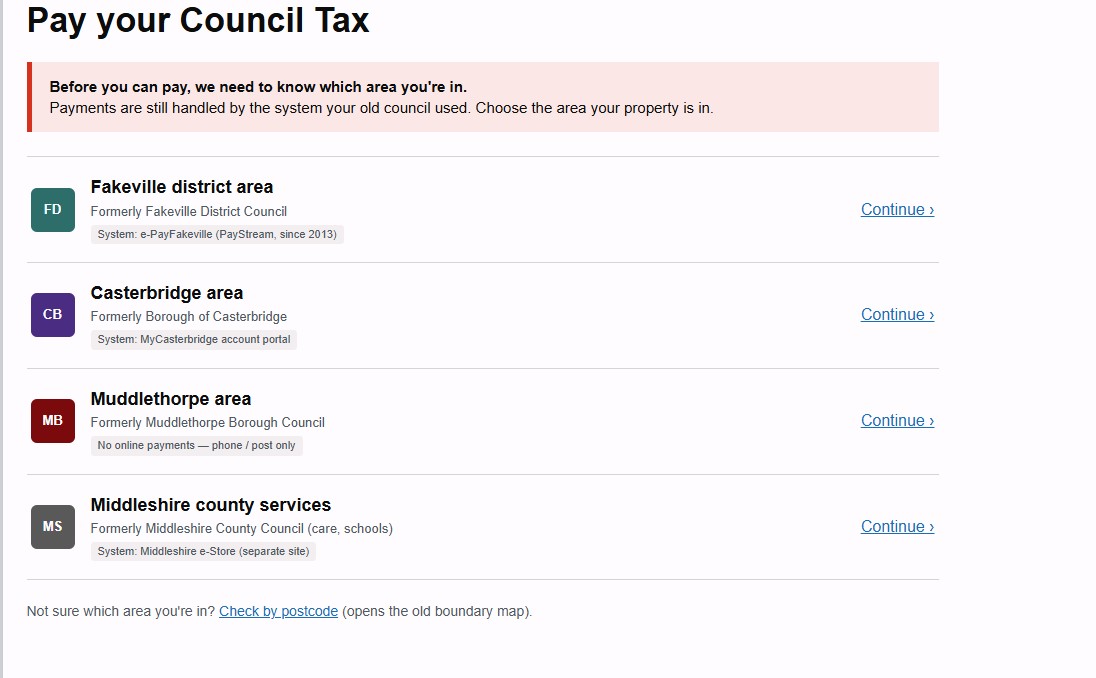
Before you can even enter a payment, you need to know which predecessor council your property falls under. Most residents won't know - and shouldn't need to. But because the new authority is still running each predecessor's payment system separately, there's no other way to route you to the right place.
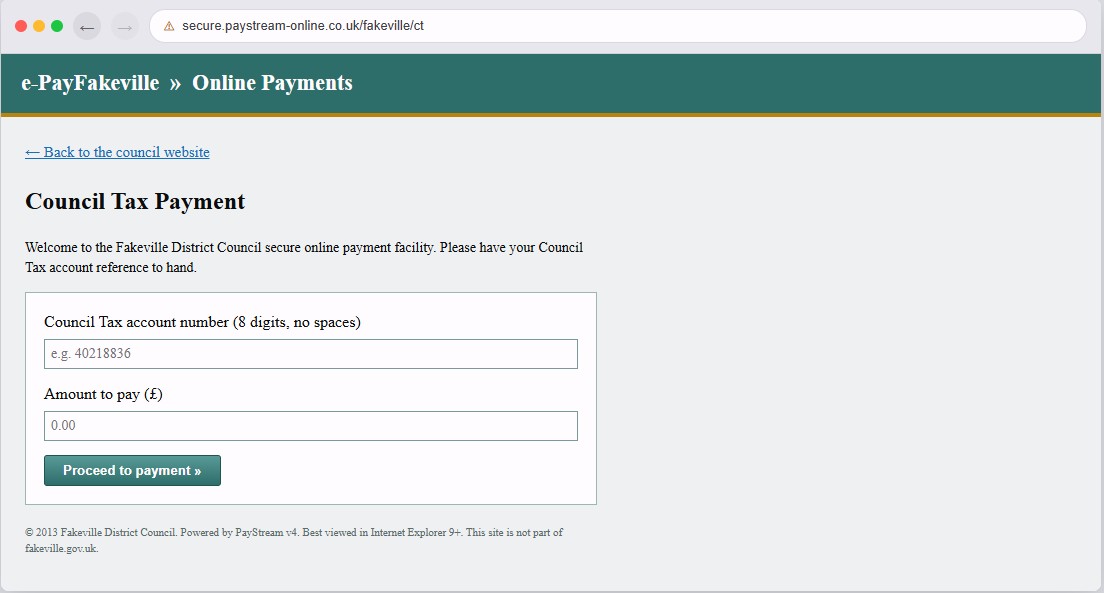
If you happen to be in the Fakeville district area, you're redirected to a third-party payment portal that was last updated in 2013:
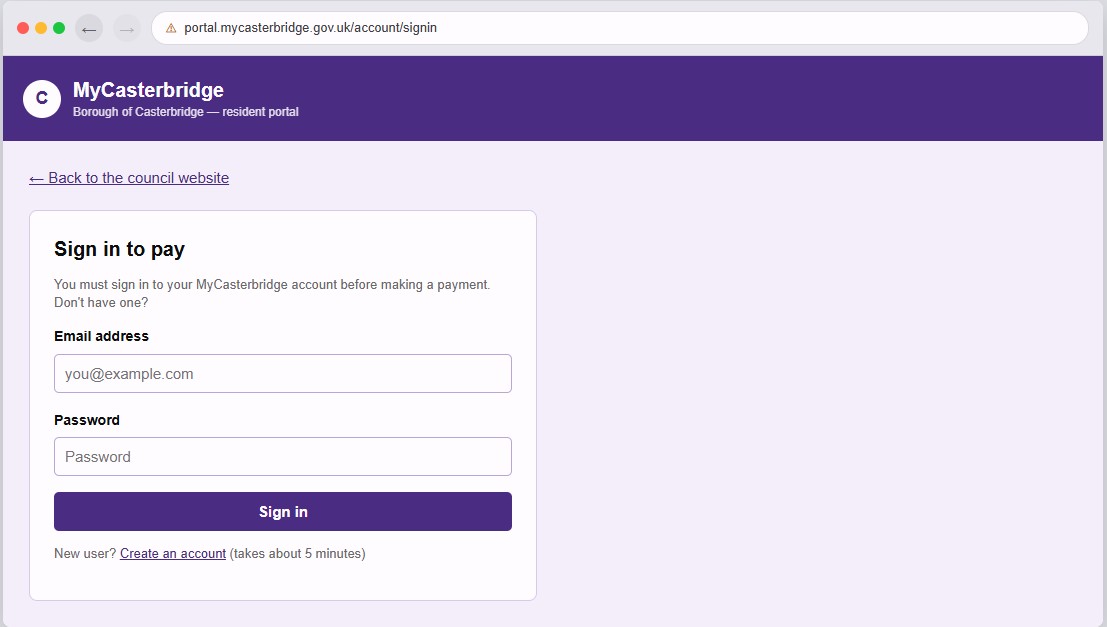
If you're in the Casterbridge area, it's a completely different experience, a resident account portal with its own login, its own branding, its own design language:
What it’s like for your teams
What the citizen sees is the visible symptom. Behind it, the finance team is dealing with multiple income management systems, each with their own reconciliation rules, suspense handling, and ledger integrations. Payments from each predecessor area flow through different channels into different bank accounts, and need to be reconciled against different back-end systems. The workarounds multiply: more spreadsheets, more manual matching, and staff working in silos based around previous boundaries.
How to get a single payment experience from Day One
The alternative is to treat income management as a day one priority, and to put a single, modern system at the centre of your payments ecosystem before vesting day, so that citizens have one place to pay, and finance has one source of truth.
That doesn't mean every legacy system has to be switched off on day one. It means the new IMS acts as the unifying layer. Payments come in through a single, branded portal. The IMS routes transactions to the correct fund and line-of-business system, and even if those back-end systems are still the legacy ones from each predecessor council. Over time, as the new authority consolidates, the Local Gov IMS adapts, but crucially, from the citizen's perspective, it's one council from day one.
Local Gov IMS specialises in being the solution for councils in LGR
Local Gov IMS was built in 2018 by Barnsley Metropolitan Borough Council, funded through the Local Digital programme, and open-sourced under AGPL-3.0, meaning the intellectual property belongs to the public sector permanently. Tailwind Digital provides the managed service: hosting, implementation, support, and ongoing development.
For LGR councils, the practical advantage of Local Gov IMS is that it’s enterprise open-source, modern, and flexible. Modern architecture (built in .NET, hosted in Azure, with open APIs) means the system can handle multiple predecessor councils' payment channels, route transactions to different back-end systems during transition, and consolidate everything as the new authority matures, without the licensing constraints that come with legacy proprietary platforms.
Getting ahead of the curve: Burnley
Burnley Borough Council is one of five authorities alongside Blackburn with Darwen, Hyndburn, Rossendale, Pendle, that will form the new East Lancashire unitary. Rather than wait for LGR to force a technology decision, Burnley chose to adopt Local Gov IMS now, so they'd be in a strong position when the merger arrives.
Rob Dobson, Burnley's Chief Operating Officer, has described the decision as forward-looking:
“Local Gov IMS will make payment journeys simpler and more effective, while supporting back-office efficiencies for our finance and operational teams. We’re working closely with Tailwind Digital to roll this out in phases across our range of services, while also recognising its potential to support the development of a future unitary council.”
Three questions worth asking now
Is your current IMS what you'd choose for your new unitary? Not whether it's tolerable today, but whether it's the system you'd pick if you were starting from scratch.
Can it adapt for LGR? Can it present a single payment experience to citizens on day one while still routing transactions to multiple legacy back-end systems?
What's the cost of waiting? Every month closer to vesting day without a plan is a month closer to defaulting to an incumbent — a decision that will shape your new council's operations for years.
Get in touch and see how we can help
Book a no-pressure discovery call with our team. We'll listen to where you are, share what we've seen work at other councils, and be honest about whether Local Gov IMS is the right fit. Or just email us at hello@tailwinddigital.io
About the author
Tom Styles
Tom has extensive experience in local government and a passion for human-centered, innovative technology. His ability to communicate with both technical and business audiences maximizes technology investment value. At Nottinghamshire County Council, Tom transformed digital services, pioneered digital tools, and modern working methods.